Theories to Apply |
||
Lev Vygotsy's Social Development Theory (1978): Major themes:
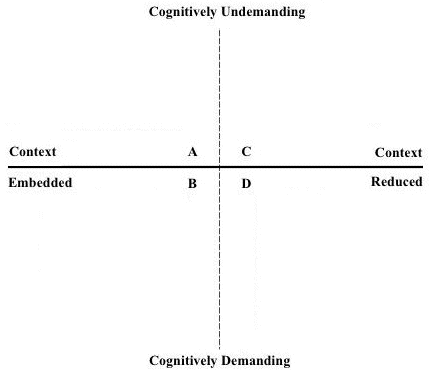
Vygotsky focused on the connections between people and the sociocultural context in which they act and interact in shared experiences (Crawford, 1996). According to Vygotsky, humans use tools that develop from a culture, such as speech and writing, to mediate their social environments. Initially children develop these tools to serve solely as social functions, ways to communicate needs. Vygotsky believed that the internalization of these tools led to higher thinking skills. Applications of the Vygotsky’s Social Development Theory Many schools have traditionally held a transmissionist or instructionist model in which a teacher or lecturer ‘transmits’ information to students. In contrast, Vygotsky’s theory promotes learning contexts in which students play an active role in learning. Roles of the teacher and student are therefore shifted, as a teacher should collaborate with his or her students in order to help facilitate meaning construction in students. Learning therefore becomes a reciprocal experience for the students and teacher. Cummins' "First and Second Language Acquisition (1981): BICS/CALPCummins makes the distinction between two differing kinds of language proficiency. BICS are Basic Interpersonal Communication Skills; these are the "surface" skills of listening and speaking which are typically acquired quickly by many students; particularly by those from language backgrounds similar to English who spend a lot of their school time interacting with native speakers. CALP is Cognitive Academic Language Proficiency, and, as the name suggests, is the basis for a child’s ability to cope with the academic demands placed upon her in the various subjects. Cummins states that while many children develop native speaker fluency (i.e. BICS) within two years of immersion in the target language, it takes between 5-7 years for a child to be working on a level with native speakers as far as academic language is concerned. Implications for mainstream teachersWe should not assume that non-native speakers who have attained a high degree of fluency and accuracy in everyday spoken English have the corresponding academic language proficiency. This may help us to avoid labelling children who exhibit this disparity as having special educational needs when all they need is more time. The non-native speakers in your classes, who have exited from the ESL program, are still, in most cases, in the process of catching up with their native speaking peers. Krashen and Terrell's "Natural Approach" (1981): "Language acquisition does not require extensive use of conscious grammatical rules, and does not require tedious drill." Stephen Krashen
"Acquisition requires meaningful interaction in the target language - natural communication - in which speakers are concerned not with the form of their utterances but with the messages they are conveying and understanding." Stephen Krashen "The best methods are therefore those that supply 'comprehensible input' in low anxiety situations, containing messages that students really want to hear. These methods do not force early production in the second language, but allow students to produce when they are 'ready', recognizing that improvement comes from supplying communicative and comprehensible input, and not from forcing and correcting production." Stephen Krashen "In the real world, conversations with sympathetic native speakers who are willing to help the acquirer understand are very helpful." Stephen Krashen |
   |
|

